Introduction
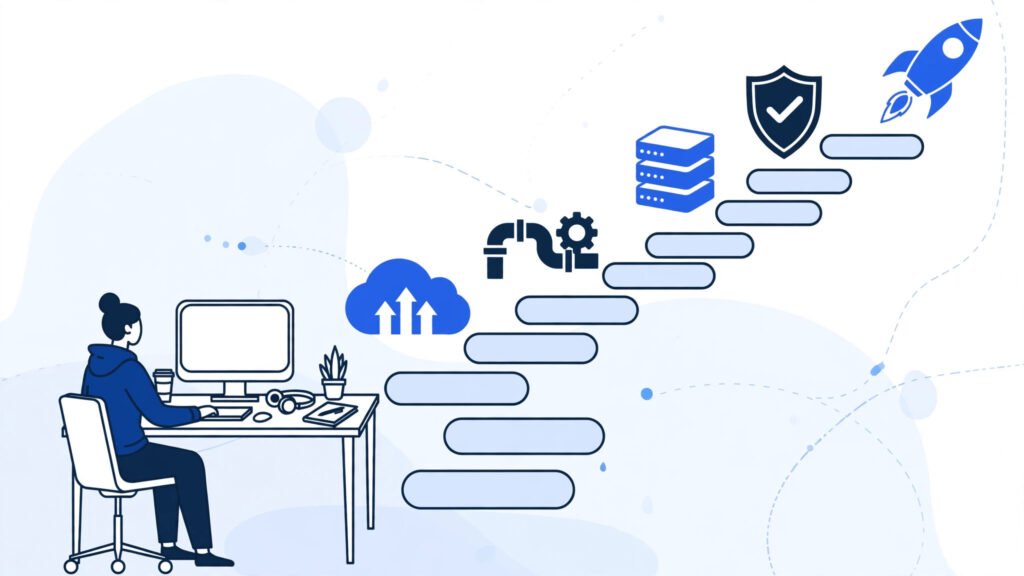
DevOps is not a single tool. It is the work of taking code from a developer’s laptop to production — reliably, repeatably and safely — and then keeping it running. If you want to become a DevOps engineer in 2026, you do not need to learn everything at once. You need a clear order: foundations first, one cloud deeply, then containers, automation and a portfolio that proves you can do the job.
This roadmap is written for beginners and career changers, and for sysadmins and developers moving sideways into DevOps. It assumes no prior cloud experience, gives realistic timeframes, and tells you what to skip. Timings are for someone studying or practising 8–12 hours a week alongside other commitments; full-time learners will move faster.
A note on the market first. Demand in 2026 has shifted from generic “DevOps engineer” titles towards platform engineering, site reliability and cloud security, and employers concentrate hiring at mid and senior levels. Junior roles exist, but they are scarcer and more competitive. That does not mean the path is closed — it means a portfolio and demonstrable production thinking matter more than a list of course certificates. This roadmap is built around that reality.
What a DevOps Engineer Actually Does
Before choosing tools, understand the job. A DevOps engineer typically:
- Builds and maintains CI/CD pipelines so code can be tested and released safely.
- Manages cloud infrastructure — networks, servers, databases — as code, not by clicking around a console.
- Runs containers and Kubernetes clusters, and fixes them when they break.
- Sets up monitoring, logging and alerting, and joins on-call rotations to respond to incidents.
- Automates repetitive work with scripts, and improves security inside the pipeline rather than after it.
You will not do all of this on day one. Junior engineers usually start with one slice — deployments, monitoring, or infrastructure tickets — and grow into owning systems end to end. The roadmap below follows that same progression.
Step 1 — Learn Linux and Networking (Weeks 1–6)
Linux is the foundation everything else stands on. Most servers, containers and CI runners are Linux, and most interviews will test it directly.
Learn:
- The filesystem, permissions (
chmod,chown), users and groups, and how processes work. - The commands in our companion guide: Linux Commands Every DevOps Engineer Should Know —
grep,awk,sed,systemctl,journalctl,ss,curland SSH. - Networking basics: DNS, HTTP/HTTPS, TCP/IP, ports, firewalls, TLS certificates and load balancing. You do not need to be a network engineer, but you must be able to explain why a service is unreachable and where to look first.
Practise: Install Ubuntu in a virtual machine or on a cheap cloud instance. Break things deliberately — stop a service, fill a disk, misconfigure a firewall — and fix them from the terminal. Keep notes; those notes become interview stories.
Skip for now: Linux kernel internals and advanced tuning. Come back to them only if a role requires it.
Step 2 — Learn Git and One Programming Language (Weeks 4–8, alongside Step 1)
Git: branching, merging, rebasing, pull requests, resolving conflicts, and a branching strategy such as trunk-based development or GitFlow. Every DevOps workflow runs through Git, so treat it as a core skill, not a side skill.
One language — Python first for most people. Python is the most useful scripting language in DevOps: automation scripts, AWS/GCP SDKs, Ansible, and glue between tools. Learn functions, files, JSON/YAML handling, HTTP requests and error handling, then write small tools: a script that checks the health of a list of URLs, or one that cleans up old log files.
Go is a strong second language, especially for platform engineering and Kubernetes tooling, but learn it after Python, not instead of it. Bash is essential too — you will pick it up naturally while working in Linux.
Step 3 — Pick One Cloud and Learn It Deeply (Months 2–4)
Do not try to learn AWS, Azure and GCP at the same time. Pick one — AWS has the largest job market in the US and UK — and learn it properly.
On AWS, learn in this order:
- IAM — users, roles, policies and least privilege. This is the most common source of both interview questions and real incidents.
- VPC networking — subnets, route tables, security groups and NAT.
- EC2, S3 and RDS — compute, object storage and managed databases.
- Lambda and API Gateway — serverless basics.
- CloudWatch — logs, metrics and alarms.
Practise: Build a small three-tier project: a static site on S3, an API on EC2 or Lambda, and a database on RDS, all in a VPC you designed. Then tear it down and rebuild it — that rebuild is where the learning happens.
Certification (optional, not a shortcut): AWS Certified Cloud Practitioner (CLF-C02) is a reasonable first exam; AWS Certified Solutions Architect – Associate (SAA-C03) is the most widely recognised associate-level credential. AWS lists 12 active certifications across Foundational, Associate, Professional and Specialty levels as of 2026. A certificate helps a CV get read, but it does not replace hands-on projects. Do not collect certificates instead of building things. For pay context, see AWS Cloud Engineer Salary in the USA, UK and Canada.
Step 4 — Containers: Docker, Then Kubernetes (Months 3–6)
Docker first. Learn images, containers, volumes, networks, multi-stage builds and how to write a clean Dockerfile. Containerise the project from Step 3.
Then Kubernetes — the skill most mid-level postings now expect. Start with the concepts, not the YAML: Pods, Deployments, Services, ConfigMaps, Secrets, Ingress and namespaces. Our Kubernetes Tutorial for Beginners explains each one in plain language with a runnable Deployment example. Practise locally with minikube or kind, which are free and run on a laptop.
A realistic Kubernetes milestone: deploy your Step 3 application to a local cluster, expose it with a Service, update it with a rolling update, roll it back, and check the logs when it fails. If you can do that without following a tutorial line by line, you are ready to talk about Kubernetes in an interview.
Certification: the Certified Kubernetes Administrator (CKA) is the hands-on credential for cluster administration — a 2-hour practical exam, 15–20 tasks, 66% to pass, $445 exam-only per Linux Foundation listings, valid for two years. It is worth pursuing after you are comfortable with kubectl, not before. Check the current exam version on the Linux Foundation site before booking; the exam environment follows new Kubernetes minor releases within weeks.
Step 5 — Infrastructure as Code and CI/CD (Months 5–7)
This is where DevOps stops being manual work and becomes engineering.
Terraform: Learn HCL, resources, variables, outputs, modules, state and remote backends. Terraform 1.17.2 was the latest release at the time of writing (11 Nov 2026). The single most important concept is state: Terraform maps each resource in your code to a real cloud object, and in a team that state must live in a shared, locked, encrypted remote backend — never on a laptop or in Git. Our Terraform Interview Questions and Answers covers state, locking, count vs for_each, modules and workspaces in the form interviewers actually ask them.
CI/CD: Learn one tool well. GitHub Actions is the best starting choice in 2026 — it is free for public repositories, YAML-based, and widely used. Build a pipeline that tests, builds a Docker image, and deploys it. Jenkins is still common in larger and older organisations, so learn its concepts (pipelines, agents, stages) once you are comfortable with GitHub Actions.
A portfolio pipeline to build: a GitHub repository where every push runs tests, builds an image, scans it, and deploys to your Kubernetes cluster. That one repository demonstrates Git, CI/CD, Docker, Kubernetes and Terraform together — and it is exactly what hiring managers ask to see.
Step 6 — Observability, Security and Reliability (Months 6–9)
Once things are running, you need to know when they break — and to keep them secure.
- Monitoring and logging: Prometheus and Grafana for metrics, plus your cloud provider’s logging. Learn SLOs, alerts that fire only when a human must act, and how to read logs to find a root cause.
- Security basics: secrets management (never commit secrets), image scanning, IAM least privilege, and policy-as-code. Security is increasingly part of the DevOps role, under the name DevSecOps.
- Reliability: backups and restores, health checks, graceful degradation, and incident write-ups. Practise writing a short post-incident note for a failure you caused in your lab: what happened, why, and what you changed.
Step 7 — Build a Portfolio and Apply (Months 7–12)
A portfolio beats a certificate list. Aim for three public, well-documented projects:
- A cloud infrastructure project — Terraform code that builds a VPC, a small application and a database, with a README explaining the design and the costs.
- A Kubernetes project — your application running on a cluster, with Deployments, Services, Ingress and monitoring.
- A CI/CD project — the pipeline from Step 5, with test results and a deployment history a reviewer can see.
Each project needs a README that explains the problem, the architecture, how to run it, and what you would improve. Hiring managers read READMEs.
Applying: Tailor your CV to each role — mirror the tools in the job description, quantify what you built (“reduced deployment time from manual to 10 minutes via GitHub Actions”), and include links to your repositories. Apply to junior, associate and platform roles, not only roles titled “DevOps engineer” — many teams hire the same skills under cloud engineer, SRE or platform engineer titles. Expect rejections; treat each interview as practice for the next.
What not to do: Do not pay for a “guaranteed job” bootcamp, do not claim experience you do not have, and do not list tools you have only watched a video about. Interviewers will ask you to use them.
A Realistic Timeline
| Stage | Time (8–12 hrs/week) | You can do |
|---|---|---|
| Linux, Git, Python basics | 6–8 weeks | Administer a server, write scripts, use Git confidently |
| One cloud (AWS) | 2–3 months | Build and run a small application in the cloud |
| Docker + Kubernetes | 2–3 months | Containerise and deploy an app, debug a failing Pod |
| Terraform + CI/CD | 2 months | Provision infrastructure as code, ship via a pipeline |
| Observability + portfolio | 2–3 months | Monitor a system, apply for junior roles with proof |
Total: roughly 9–12 months from zero to job-ready for a junior role. People with a sysadmin or developer background often move faster, because they already own half the foundation.
Frequently Asked Questions
How long does it take to become a DevOps engineer? For most beginners studying part-time, 9–12 months to a junior role is realistic. It can be shorter with prior IT experience, and longer if you try to learn three clouds and five tools at once. Depth in one stack beats breadth across many.
Do I need a degree to become a DevOps engineer? No. Most employers in the US, UK, Canada and Australia hire on demonstrable skill — a portfolio, practical experience and the ability to explain your decisions. A degree can help, but it is not a requirement for most postings.
Which cloud should I learn first? AWS, for the largest number of job postings. If you already work in a Microsoft shop, Azure is a reasonable first choice, and its AZ-104 certification is the anchor for Azure roles. Learn one deeply before adding a second.
Is DevOps a good career in 2026? Yes, with the caveat that the market rewards mid and senior engineers most. Junior roles are competitive, so a portfolio and real project experience matter. Pay varies widely by country, experience and employer — see our salary guide for ranges with sources.
Do I need to learn Kubernetes to get a DevOps job? For most mid-level roles, yes — Kubernetes appears in the majority of DevOps postings. For some junior or AWS-focused roles, Docker and cloud skills may be enough to start, but Kubernetes should be on your plan within the first year.
Conclusion
The DevOps roadmap is not a race to collect tools. It is Linux, Git and Python; one cloud learned deeply; Docker and Kubernetes; Terraform and CI/CD; then observability and a portfolio that proves it all. Work through the steps in order, build something at each stage, and write down what you learned. In a year’s time, you will not just have a list of skills — you will have systems you built, broke and fixed, and that is what gets you hired.
Next step: start with Linux Commands Every DevOps Engineer Should Know and set up a free-tier cloud account and a local Kubernetes cluster this week.